Earring Gauge Guide: What Gauge Are Normal Earrings?

If you are buying earrings for a piercing you already have, gauge is the first number to check. It works backwards: the higher the number, the thinner the post. Here is what each gauge means in millimetres, what gauge everyday earrings are, and how to change sizes without forcing anything.
The short answer
Earring gauge is the thickness of the post, and a higher number means a thinner post: 20g is 0.8mm, 18g is 1.0mm and 16g is 1.2mm. Normal earrings are not made to one standard gauge, so check the product details before you buy. Post length is a separate measurement, and a thicker post should never be forced in.
- 0.8mm20 gauge (20g). The higher the gauge number, the thinner the post.
- 1.2mm16 gauge (16g), the post thickness of most rhokea flat back studs.
- One sizeThe most to go up at a time, and never by force, says the Association of Professional Piercers.
What does gauge mean for earrings?
Gauge is the thickness of the part of an earring that passes through your ear: the post of a stud, or the wire of a hoop. In the US, jewellery thickness is usually given in gauge. Outside the US, millimetres are common.1
The system comes from wire. The gauge used for piercing jewellery is the Brown & Sharpe wire gauge,1 known today as the American Wire Gauge. Like many wire gauges, its numbers run backwards: a larger number means a thinner wire.2 So 20g is thinner than 18g, and 18g is thinner than 16g.
How big is each earring gauge in millimetres?
The jewellery sizes below come from the Association of Professional Piercers (APP) size chart, which starts at 20g.1 Its figures are simplified, so the exact American Wire Gauge sizes are shown alongside.2
| Gauge | Jewellery size (APP) | Exact wire size |
|---|---|---|
| 22g | Not on the chart | 0.64mm |
| 20g | 0.8mm | 0.81mm |
| 18g | 1.0mm | 1.02mm |
| 16g | 1.2mm | 1.29mm |
| 14g | 1.6mm | 1.63mm |
So a listing that says 16g or 1.2mm means the same post. As for 16g vs 18g, 16g is the thicker of the two, by 0.2mm.
What gauge are normal earrings?
There is no single standard. Post thickness is set by each maker and varies by style, even within one brand. Our own sizes, for example:
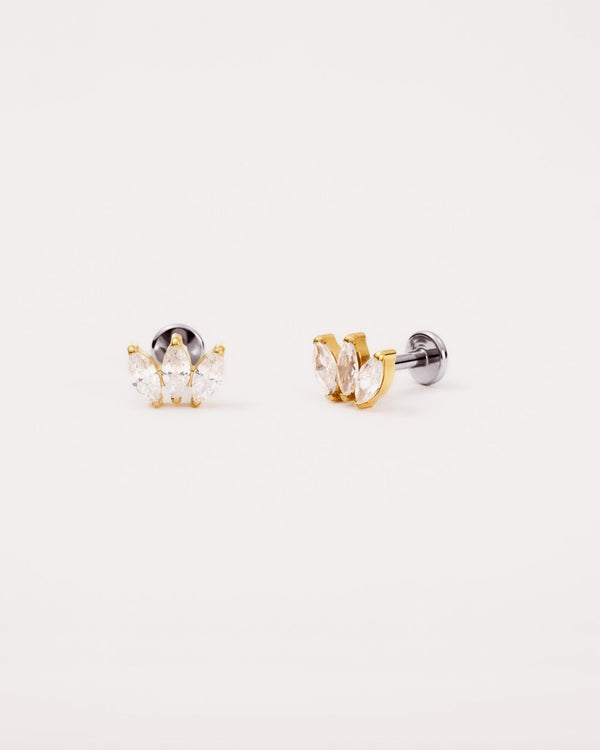
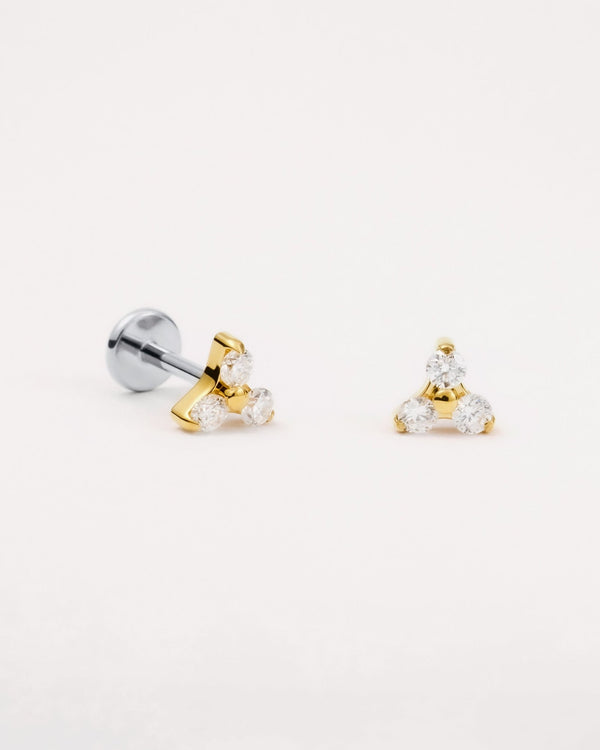
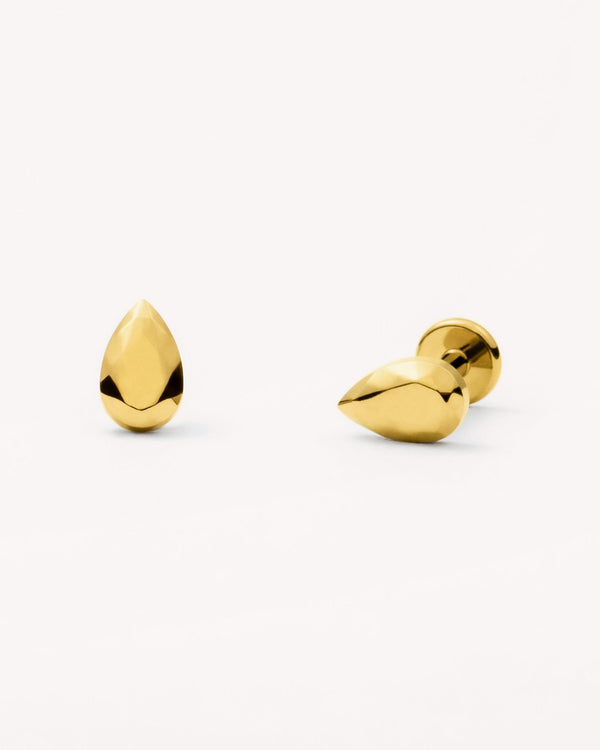
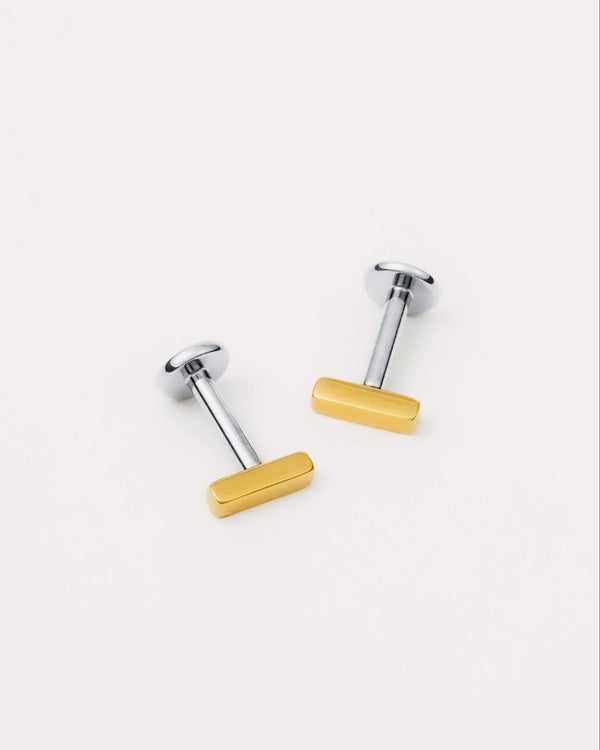
- Flat back studs: most are 1.2mm (16g) with a 6mm post. Some are 1.0mm (18g), also with a 6mm post, and several of these come with extra 8mm posts.
- Replacement posts: 1.0mm or 1.2mm, each 6mm or 8mm long.
- Classic, Duet and Pavé piercing hoops: 1.2mm (16g).
- Huggies and hoop earrings: 0.8mm or 1.0mm, depending on style. Mini Pavé Hoop Huggies are 0.8mm; Small Huggie Hoop Earrings are 1.0mm.
- Nose studs and nose hoops: 0.8mm (20g). See our guide to nose stud sizes.
What matters is how a new earring compares with the jewellery you wear now. A thinner post needs no stretching. A thicker one has to stretch the piercing to fit, which is why it should never be forced.1 Before you buy, check the product details for the post thickness. If a listing does not say, ask the brand.
What gauge do I need for a lobe or cartilage piercing?
There is no fixed gauge for either. The APP says the first jewellery in a piercing must be an appropriate gauge, and that jewellery which is too thin may be treated by the body like a splinter, leading to migration or rejection.3 Your piercer chooses that size. Once the piercing has healed, the simplest rule is to keep wearing the gauge it healed with.
Placement matters for length too. The APP notes that the studs used in ear piercing guns are too short for some earlobes and most cartilage.4 For cartilage, check the post length as carefully as the gauge.
Is post length the same as gauge?
No. Gauge is thickness; length is the wearable part of the post, such as 6mm or 8mm. The two are chosen separately, so the same 1.2mm gauge can come as a 6mm or an 8mm post. For hoops, diameter is a third measurement, covered in our hoop earring size guide.
Most new piercings need jewellery with extra length to leave room for swelling. Once swelling settles, a post that is too long can snag and move around, causing irritation. The APP advises going back to your piercer for a shorter post, a step called downsizing, because the piercing is not yet healed enough to change jewellery yourself.5 For a healed piercing, here is how to insert threadless flat back studs.
How do I find my gauge and switch safely?
- Check the product detailsThe listing or packaging for jewellery you already own should give the post thickness in gauge or millimetres.
- Measure the postUse callipers on the post itself, not the decorative front. A ruler is too coarse to show a 0.2mm difference.
- Ask your piercerThe piercer who did your piercing can tell you the gauge they used, or measure your jewellery for you.
Going thinner needs no stretching, but watch the weight. The APP warns that jewellery that is too thin can cut through tissue, and that charms or heavy weights on thin wire make this more likely.5
Going thicker is stretching. The APP advises going up no more than one gauge at a time, never forcing jewellery in, and stopping if it does not go in easily. It treats insertion tapers as a professional instrument,1 so if you want to size up, see a professional piercer.

Know your size
Threadless flat back studs
Each has a 6mm post in polished ASTM F136 implant-grade titanium, in 1.2mm (16g) or 1.0mm (18g). Check the gauge on each product page; several 1.0mm styles come with extra 8mm posts.
Shop flat back studsEarring gauge FAQs
What gauge are normal earrings?
There is no single standard gauge for normal earrings. Post thickness varies by brand and style, and even our own range includes 0.8mm (20g), 1.0mm (18g) and 1.2mm (16g) posts. Check the product details for the post thickness, and compare it with the jewellery you already wear.
Is 16g or 18g thicker?
16g is thicker. With gauge, a lower number means a thicker post: 16g is 1.2mm and 18g is 1.0mm, a difference of 0.2mm. If your piercing is used to 18g, do not force a 16g post in. Go up one size at a time, or ask a professional piercer.
How big is a 16 gauge earring?
A 16 gauge earring post is 1.2mm thick on the jewellery size chart used by the Association of Professional Piercers. Gauge only describes thickness, so the post length, such as 6mm or 8mm, and the size of the front are separate measurements to check.
What gauge earrings do I need for my lobe?
There is no fixed gauge for lobes. The best fit is the gauge your piercing healed with, which your piercer can tell you, or which you can measure from your current jewellery. A thinner post needs no stretching. To go thicker, go up one size at a time and never force it.
What does gauge mean for earrings?
Gauge is the thickness of the part of an earring that passes through your ear. It comes from the American Wire Gauge, where a higher number means thinner wire, so 20g (0.8mm) is thinner than 16g (1.2mm). Outside the US, jewellery is often sized in millimetres instead.
What is the smallest earring gauge?
The thinnest size on the jewellery chart used by the Association of Professional Piercers is 20g, or 0.8mm. Higher numbers are finer still: on the American Wire Gauge, 22 gauge is 0.64mm. In our range, nose jewellery and some huggies use 0.8mm posts.
Sources
- Association of Professional Piercers. Stretching your piercing, brochure (2017 edition), with gauge size chart. APP (PDF)
- US National Bureau of Standards (now NIST). Copper Wire Tables, Handbook 100 (1966): the American Wire Gage and Table 1. NIST (PDF)
- Association of Professional Piercers. Jewelry for initial piercings. APP
- Association of Professional Piercers. Piercing guns. APP
- Association of Professional Piercers. Piercing FAQ: why it is important to downsize a piercing, and how to avoid hurting your piercing. APP