Earrings for the Gym, the Pool and the Run: A Doctor's Guide to Training in Your Jewellery

Everyday Wear
Search "gym jewellery" and you will be told sweat is the enemy and only a "sweat proof" pair can survive it. The aftercare evidence says something different, and more useful. Sweat is largely a non-issue; the documented risks to pierced ears during sport are friction, pressure and knocks, plus water you submerge a healing piercing in. Here is what the evidence actually supports, activity by activity, and what that means for the pair you train in.
Informational only: general information, not personal medical advice. A healing piercing has its own rules: keep it out of pools and open water until healed, and see our swimming after a piercing guide for the timeline.
The sweat myth
The "sweat proof jewellery" category is built on a fear the evidence does not share. The Association of Professional Piercers, the body whose standards piercers actually follow, says it plainly: "Exercise and sweating during healing is fine. Avoid activities that could jostle or aggravate the piercing."1 If sweat were the hazard, the strictest guidance in the industry would say so. It says the opposite, and points at movement instead.
Sweat is not entirely nothing: it is a warm, mildly salty solution, and over months it stresses plated coatings and unnamed alloys, which is a metal problem rather than a piercing problem. We cover that chemistry, and why solid metals shrug it off, in our guide to what sweat and pools do to stainless steel. For your ears, the useful worry is elsewhere.
The real risks: friction, pressure, knocks
Three mechanical forces do the documented damage. Pressure: case reports describe constant pressure from earring backs compressing the skin until it breaks down, with backs ending up embedded in the earlobe.2 In a series of 100 embedded-earring cases in a children's emergency department, the posterior part, the back, was the culprit in 68.3 Friction and shear: mechanical forces on healing skin are an established driver of irritation and problem scarring, including the bumps and thickened scars pierced ears are prone to.5
And traction: sudden pulls and long-term load are the accepted causes of elongated piercing holes and split lobes, with post-traumatic tearing among the most common earring complications surgeons see.67 Every one of these risks scales with how much your jewellery sticks out, swings, snags and weighs. None of them scales with how much you sweat.
The gym
Lifting and studio sessions are friendlier to earrings than they look. Sweat is fine;1 the real gym-specific issues are pressure and hygiene. Headphones, hats and anything that clamps the ear press the earring back into the skin for the length of the session, which is exactly the mechanism behind pressure damage.2 Flat back studs spread that load over a smooth disc; butterfly backs concentrate it on a sprung clasp.
The hygiene point comes straight from aftercare guidance: shared equipment and mats carry bacteria, so if your piercing is still healing, keep it clean and keep it off the bench.1 Towel-drying is the classic snag moment for hoops and anything dangly. Small, fixed, flush jewellery removes the hazard rather than managing it.
The pool and open water
Two separate questions hide in "can I swim in my earrings". If the piercing is healing, the answer is no: aftercare guidance says avoid submerging it in pools, lakes, hot tubs and the sea, or protect it with a waterproof dressing, because the open channel is exposed to whatever is in the water.1 Infection is the complication the NHS specifically warns about with new piercings.8
If the piercing is healed, the question is about the metal. Public pools run at roughly 1 to 3 mg/l of free chlorine, hot tubs higher,9 and chloride is the one chemical family that slowly attacks plated and lower-grade jewellery metals; titanium is indifferent to it. Rinse and dry after swimming whatever you wear, and if you want the full ranking of metals in water, our waterproof jewellery guide covers it. The remaining risk is the obvious one: loose butterfly backs and open water are how earrings get lost.
Running and impact sport
Running is repeated impact, and impact is jostling, the exact thing aftercare guidance tells you to avoid doing to a piercing.1 A healed lobe tolerates it well if the jewellery barely moves. Mass is the variable you control: titanium is about 45 percent lighter than stainless steel for the same design,4 and a lighter earring carries less momentum with every footstrike. Swinging hoops and drops turn each stride into a small tug on the piercing, the slow version of the traction that elongates holes.6
For contact and team sport the UK default is removal: the Association for Physical Education strongly recommends taking off all personal effects, including all ear and body piercings and retainers, at the start of every PE lesson.10 That is about impact and entanglement, not sweat, and it is sensible guidance for adult contact sport too. For everything else, the answer is jewellery that behaves as if it is not there.
What to wear for training
| Situation | What works | What to avoid |
|---|---|---|
| Gym and studio | Threadless flat back studs; small fitted huggies | Butterfly backs under headphones; dangly designs near towels |
| Swimming, healed piercing | Solid titanium, snug fit; rinse and dry after | Plated or unnamed metals; loose backs that can slip off |
| Swimming, healing piercing | No submersion until healed, or a waterproof dressing1 | Pools, hot tubs, lakes and sea water1 |
| Running | Lightest pair you own, fixed and flush4 | Hoops and drops that swing with each stride |
| Contact sport and PE | Remove jewellery for the session10 | Taping over as a routine substitute for removal |
| All of the above | Internally threaded or threadless, mirror-finish jewellery11 | Cheap "sports studs": market tests keep finding nickel release12 |
The specification in that last row is not ours; it is the piercing industry's. Jewellery standards require internally threaded or threadless designs with a smooth, mirror finish, because rough surfaces let healing tissue grow into irregularities and tear on movement.11 It matters doubly for training, where movement is the whole point. And with around one in seven European adults sensitised to nickel,13 the unnamed alloys cheap sports studs are made from are the worst possible partner for long sweaty sessions: market studies keep finding jewellery releasing nickel above the legal limit.12 Our flat back vs butterfly back comparison goes deeper on the backs question.
What we recommend
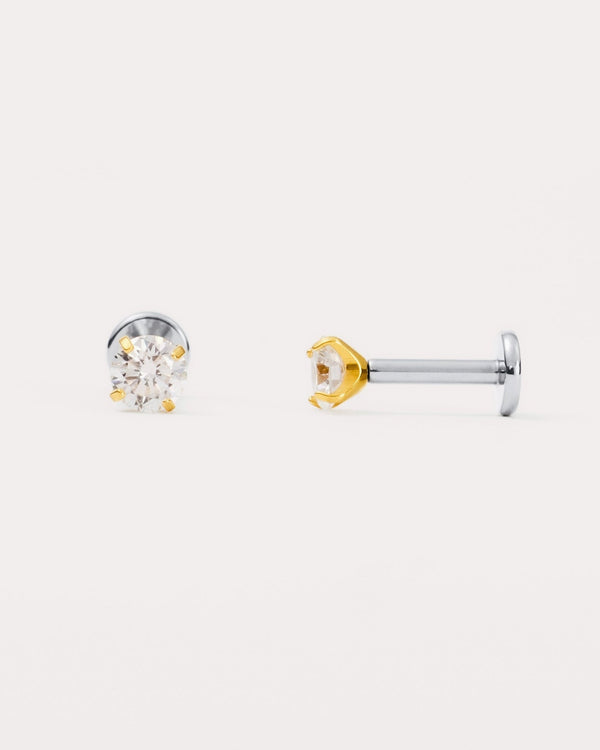
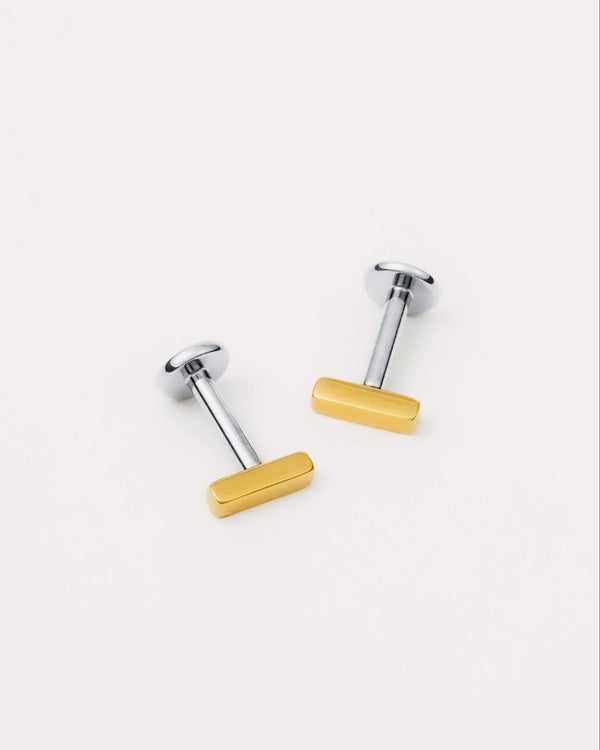
The training brief, light, snug, smooth, flat backed, nickel-free, is the design brief our range is built to. Start with the flat back studs collection: threadless implant-grade titanium pairs you can train, shower, swim and sleep in without taking them out.
How rhokea handles this
Rhokea was founded by a doctor for reactive skin. Every piece is machined from ASTM F136 implant-grade titanium with a threadless flat back design and a smooth finish, so there is no clasp to press into your ear, no thread to catch healing skin, no plating for sweat and pool water to strip, and no nickel behind any of it. At roughly half the weight of steel, it also simply moves less when you do.
Independent Intertek certification (December 2025) measured nickel release below 0.1 µg/cm²/wk, under half the UK and EU legal limit, with ASTM F136 composition confirmed.
Shop flat back studsFrequently asked questions
Can you wear earrings to the gym?
Yes, with the right pair. The evidence-based risks are mechanical, not chemical: friction from towels and headphones, pressure against the head, and snagging on kit. Small, snug, threadless flat back studs or fitted huggies sit flat and avoid all three. Large hoops, dangly designs and butterfly backs are the styles worth leaving in the locker.
Does sweat damage earrings or piercings?
Less than the marketing suggests. The Association of Professional Piercers states plainly that exercise and sweating during healing is fine. Sweat is a mild chloride solution, so over time it stresses cheap plated metals, but it does not harm a healed piercing and it does not touch implant-grade titanium. The things that actually cause trouble are friction, pressure and knocks.
Can you work out after getting a new piercing?
Generally yes. Piercing aftercare guidance allows exercise during healing; what it warns against is jostling or aggravating the piercing, and contact with bacteria on shared gym equipment and mats. Keep the area clean, avoid activities that knock the jewellery, and skip anything that presses kit directly onto it, such as tight helmet straps over a healing cartilage piercing.
Can you swim with earrings in?
With a healed piercing and a solid, inert metal, yes. Pool chlorine and seawater are chloride environments that slowly attack plated and lower-grade metals, so rinse jewellery in fresh water after swimming. Titanium is unaffected. The bigger practical risk is simply losing an earring in the water, which is another argument for snug flat backs over loose butterfly backs.
Can you swim with a new piercing?
No. Aftercare guidance is to avoid submerging a healing piercing in pools, lakes, hot tubs and the sea, because the open channel is exposed to bacteria in the water. The NHS notes that infected piercings often follow poor early care. Wait until the piercing is fully healed, or protect it with a waterproof dressing if a swim is unavoidable.
What are the best earrings for running?
Light, small and fixed. Running adds repeated impact, so the jewellery brief is minimal mass and no free movement: threadless flat back studs or small fitted huggies rather than swinging hoops. Metal choice matters for weight as well as skin: titanium is roughly 45 percent lighter than stainless steel for the same design, so a titanium pair simply moves less.
Do heavy earrings stretch your ears?
The plastic surgery literature treats long-term wear of heavy earrings, and sudden pulls on an earring, as the accepted causes of elongated piercing holes and split earlobes, and torn lobes are among the most common earring complications surgeons repair. No study has measured exact weight thresholds, so the honest advice is simple: for daily and active wear, lighter is safer.
Why does my ear hurt after headphones or a helmet?
That is pressure, the best-documented mechanical enemy of pierced ears. Constant pressure on an earring can compress the skin beneath it, and case reports describe pressure from earring backs leading to skin breakdown and even embedding. Flat back studs spread load over a smooth disc rather than a clasp, which is why they cope better under headphones, helmets and sleep.
Do children have to remove earrings for PE in the UK?
Usually yes. The Association for Physical Education strongly recommends removing all personal effects, including all ear and body piercings and retainers, at the start of every PE lesson, and many schools set their policy accordingly. If a child cannot yet remove a healing piercing, schools commonly ask for it to be taped or for the child to sit out contact elements.
What earrings can you wear 24/7 through training, showers and sleep?
A pair that is solid implant-grade titanium, threadless, flat backed and mirror finished. That combination is nickel-free by composition, indifferent to sweat and water, smooth enough not to irritate the piercing channel, and flat enough to sleep and train on. It is the same specification piercing bodies set for jewellery worn in healing piercings, applied to everyday life.
References
- Association of Professional Piercers. "Suggested Aftercare for Body Piercings." APP
- Fijałkowska M, Pisera P, Kasielska A, Antoszewski B. "Should we say NO to body piercing in children? Complications after ear piercing in children." International Journal of Dermatology, 2011; 50(4):467-469. PubMed
- Timm N, Iyer S. "Embedded earrings in children." Pediatric Emergency Care, 2008; 24(1):31-33. PubMed
- Materials datasheets: ASM/MatWeb, "Titanium Ti-6Al-4V (Grade 5), Annealed" (density 4.43 g/cm³); AZoM, "Stainless Steel, Grade 316L, UNS S31603" (density 8.0 g/cm³). MatWeb / AZoM
- Ogawa R. "Mechanobiology of scarring." Wound Repair and Regeneration, 2011; 19(s1):s2-s9. PubMed
- Hemdani R, Chatterjee M, Markanday K. "A Comparative Study of Elongation of Earlobe Following Two Different Modalities for Repair of Posttraumatic Split of Earlobe." Journal of Cutaneous and Aesthetic Surgery, 2020; 13(1):5-10. PMC
- Fijałkowska M, Kasielska A, Antoszewski B. "Variety of complications after auricle piercing." International Journal of Dermatology, 2014; 53(8):952-955. PubMed
- NHS. "Infected piercings." Accessed August 2026. NHS
- World Health Organization. Guidelines for Safe Recreational Water Environments. Volume 2: Swimming Pools and Similar Environments. WHO, 2006. WHO
- Association for Physical Education. "Health & Safety Update: Jewellery." October 2024. afPE
- Association of Professional Piercers. "Jewelry for Initial Piercings." APP
- Hamann D, Hamann CR, Kishi P, Menné T, Johansen JD, Thyssen JP. "Jewellery: alloy composition and release of nickel, cobalt and lead assessed with the EU synthetic sweat method." Contact Dermatitis, 2015; 73(4):231-238. PubMed
- Schuttelaar MLA, Ofenloch RF, Bruze M, et al. "Prevalence of contact allergy to metals in the European general population with a focus on nickel and piercings: The EDEN Fragrance Study." Contact Dermatitis, 2018; 79(1):1-9. PMC