Flat Back Earrings: The Complete UK Buying Guide

Buying Guide
Flat back earrings started in piercing studios and migrated to everyday jewellery boxes for a simple reason: the design is kinder to ears than the century-old butterfly stud. But buying them involves choices the butterfly never asked of you, including gauge, post length and fastening system. This guide covers all of it, so the pair you order fits the first time.
Informational only: general medical information, not personal advice. Sizing for a newly pierced or healing ear should come from your piercer.
What flat back earrings are
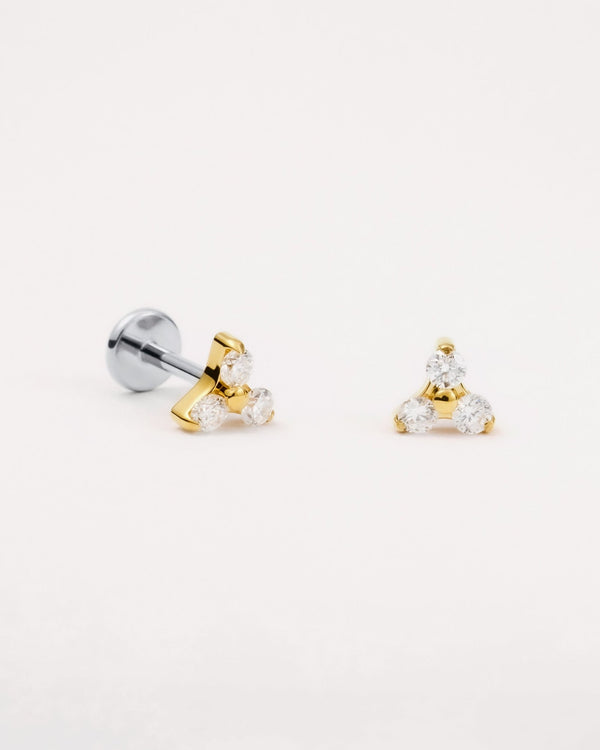
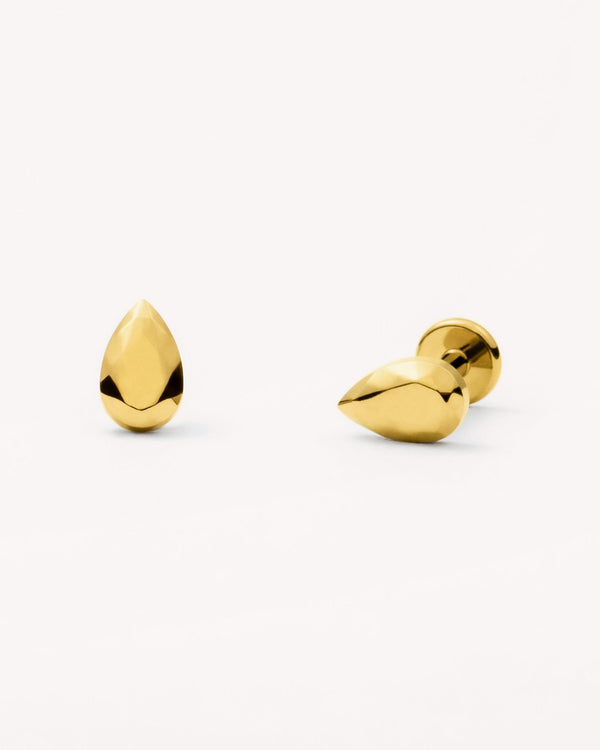
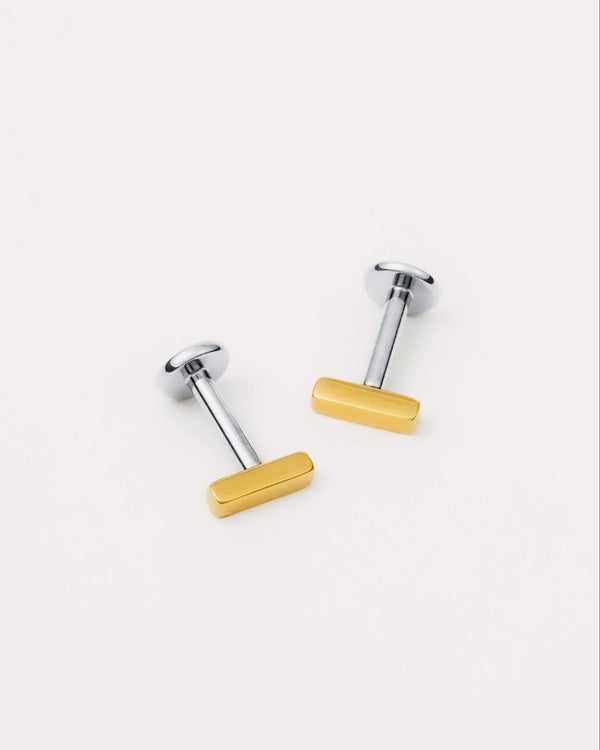
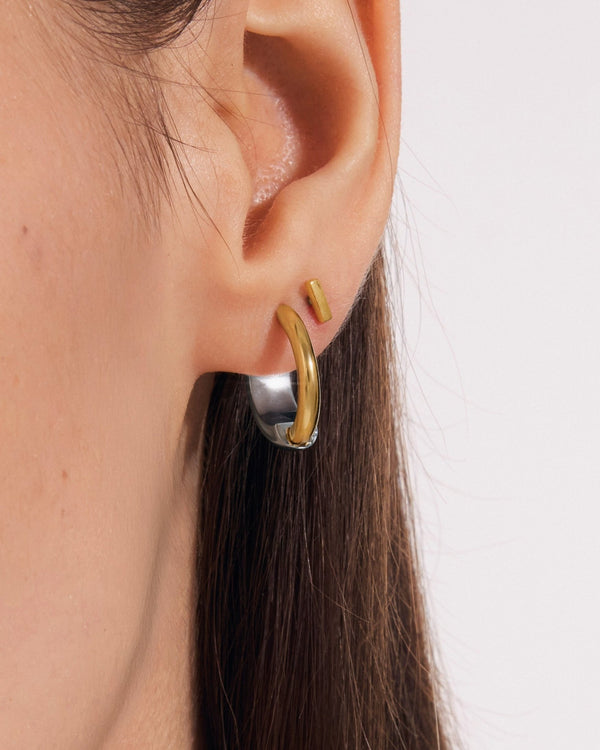
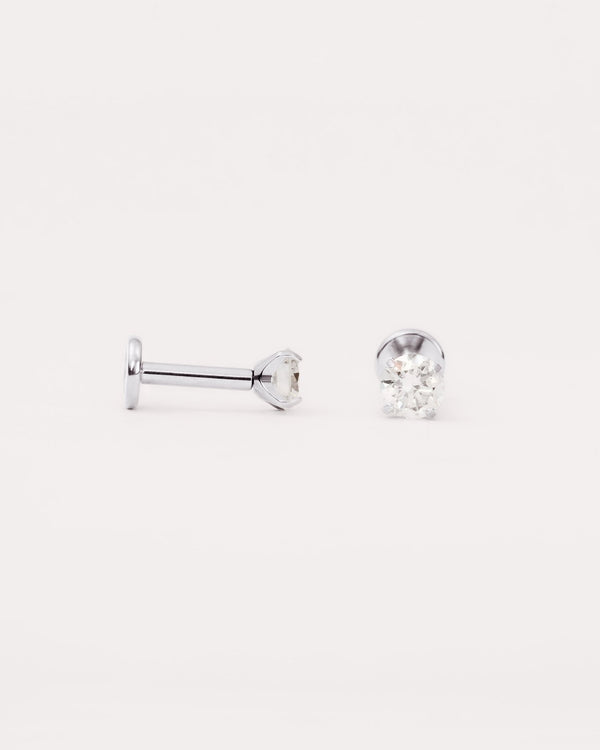
A flat back earring reverses the classic stud. Instead of a post pushed through from the front and clamped by a butterfly behind, the post enters from behind the ear and ends in a smooth, flat disc that sits flush against the skin. The decorative element attaches at the front. The format comes from piercing studios, where it is called a labret stud, and it is the initial jewellery professional piercers reach for across most ear placements.1
The consequence of the reversal is what you no longer have: no clamp squeezing the lobe, no coiled butterfly harbouring debris, and no sharp post tip pointing into your neck at night. If you want the head-to-head comparison, our flat back vs butterfly back guide covers it in detail.
Threadless vs screw-on
| Feature | Threadless (push-fit) | Screw-on |
|---|---|---|
| How it holds | A slightly bent pin friction-locks inside the hollow post | The top threads onto (external) or into (internal) the post |
| Changing tops | Pull off, push on; tops swap across the range in seconds | Unscrew and re-tighten; slower but familiar |
| Comfort detail | No exposed thread anywhere near skin | Internal threading keeps the thread out of the channel |
| Security | Secure when fully seated; test with a gentle tug | Marginally more positive lock for very active wear |
| Best for | Frequent top-swappers, curated ear styling | Set-and-forget wearers |
Our range is threadless: one post, any top, no tools. If you have never inserted one, our step-by-step insertion guide shows the technique.
Gauge and post length
| Placement | Typical gauge | Healed snug length | Note |
|---|---|---|---|
| Lobe | 18g or 16g | 5.5 to 6.5 mm | Thicker lobes may prefer 8 mm |
| Helix / flat helix | 16g | 5 to 6.5 mm | Downsize after healing to avoid snag leverage |
| Tragus | 16g | 5 to 6 mm | Small anatomy; snug fit matters for earbuds |
| Conch | 16g | 6 to 8 mm | Central cartilage is thicker |
| New piercing | Piercer's choice | Longer, to allow swelling | Fitted by the piercer, downsized once healed1 |
Two rules save most sizing mistakes. First, measure the post, not the sparkle: length is the wearable bar between disc and top. Second, a healed piercing wants a snug fit; excess length gives the earring leverage to tilt and catch. A post left over-long after healing is the most common reason a flat back feels less comfortable than promised. If a currently comfortable piercing has started aching, our guide to why earring holes hurt walks through the causes.
Why the flat disc is kinder to ears
The butterfly stud concentrates force twice: the coiled back clamps the lobe, and the excess post ends in a cut tip that presses into the skin behind, particularly during sleep. The flat disc does neither. Pressure from a pillow spreads across the whole disc face, and there is no post tip because the post ends at the disc.
The clamp design has a further documented failure mode: earring backs pressed tight against a lobe can become embedded in the tissue, a complication reported particularly in children and after gun piercings.23 A disc that sits flush cannot burrow the same way. This is why paediatric and piercing literature favours simple, appropriately sized jewellery, and why we build our studs on the labret format across the range: see our guide to every earring back type for the full comparison.
Materials and UK standards
UK and EU law limits how much nickel an earring post may release into skin, measured by the EN 1811 reference test at 0.2 µg/cm²/week for post assemblies.5 The limit helps, but field studies of earrings bought in ordinary shops and markets, including in London, have repeatedly found pairs exceeding it.7 And with around 17.6% of women sensitised to nickel, a legal-but-borderline earring worn 24/7 can still be enough to react.8
The robust answer is a material with nothing to release. Implant-grade titanium, specified by ASTM F136 for surgical implants, contains no nickel and forms a stable oxide surface that does not corrode in sweat or water.46 It is also roughly half the weight of steel, which a wearer notices most in a stud that never comes out. Professional piercing bodies specify implant-grade materials for initial jewellery for the same reasons.1
How rhokea handles this
Rhokea was founded by a doctor for reactive ears. Every flat back stud is machined from ASTM F136 implant-grade titanium with a threadless push-fit post and a smooth polished disc. SkinPlating, our anodised finish, has no plating layer to wear through, so there is no nickel-bearing base metal waiting underneath.
Independent Intertek certification (December 2025) measured nickel release below 0.1 µg/cm²/wk, under half the UK and EU legal limit, with ASTM F136 composition confirmed.
Shop titanium flat back studsWhat we recommend
Start with the placement, size to a snug post, and let the material be non-negotiable. For healed lobes, an 18g or 16g titanium flat back at 5.5 to 6.5 mm suits most people; for cartilage, match the lengths above and downsize once any residual swelling settles. Every piece in our implant-grade titanium flat back studs collection uses the same threadless post system, so tops interchange freely as your ear stack evolves.
Frequently asked questions
What are flat back earrings?
Flat back earrings, also called labret studs, reverse the classic stud design. The post enters from behind the ear and ends in a smooth flat disc that sits flush against the skin, while the decorative top attaches at the front by push-fit (threadless) or screw thread. There is no butterfly clamp and no sharp post tip.
Are flat back earrings better for sensitive ears?
The design removes two common irritants: the clamp pressure of a butterfly back and the sharp post tip that presses into the back of the ear during sleep. Combined with a nickel-safe metal such as implant-grade titanium, flat backs are the most comfortable stud format for reactive ears and for anyone who sleeps in earrings.
What is the difference between threadless and screw-on flat backs?
Threadless (push-fit) tops have a slightly bent pin that friction-locks inside the hollow post; you push to fit and pull to remove. Screw-on tops thread onto or into the post. Threadless is quicker to change and has no thread to catch skin; screw-fit holds marginally more securely for very active wear. Both are secure day to day.
What size flat back earrings do I need?
Two measurements matter: gauge (post thickness, usually 16g or 18g for ear piercings) and post length. For healed lobes, 5.5 to 6.5 mm is the usual snug length; healed cartilage typically takes 5 to 6.5 mm depending on anatomy. A freshly pierced ear needs a longer post to allow for swelling, which your piercer will downsize once healed.
Can you sleep in flat back earrings?
Yes, on a healed piercing this is the stud format designed for it. The smooth disc spreads pillow pressure across a wider area instead of concentrating it into a clamp and a point, which is why flat backs are the standard recommendation for people who never take their earrings out.
Are flat back earrings good for new piercings?
Professional piercers fit labret-style flat backs as initial jewellery for many ear piercings, in implant-grade materials and with extra post length for swelling. For a new piercing, buy through your piercer so the length is right, then switch to a snug fit once healed.
What metal should flat back earrings be made of?
Implant-grade titanium (ASTM F136) is the benchmark: no nickel release, no corrosion in sweat or water, and about half the weight of steel. UK and EU law limits nickel release from earring posts, but plated fashion metals can still cause reactions once plating wears. Named standards beat vague words like hypoallergenic.
How do you change a flat back earring?
For threadless: hold the disc steady, grip the top and pull straight off, then push the new top's pin into the post until it seats. For screw-fit: hold the disc and unscrew the top anticlockwise. Clean hands and a mirror help; a dab of friction from a rubber glove makes gripping small discs easier.
Do flat back earrings fall out?
A correctly seated threadless top or fully tightened screw top is secure through sleep, showers and exercise. Most losses come from tops seated in a hurry or threads left half-tightened. Check the fit after inserting: a threadless top should resist a gentle tug, and a screw top should not rotate freely.
Which piercings can you wear flat backs in?
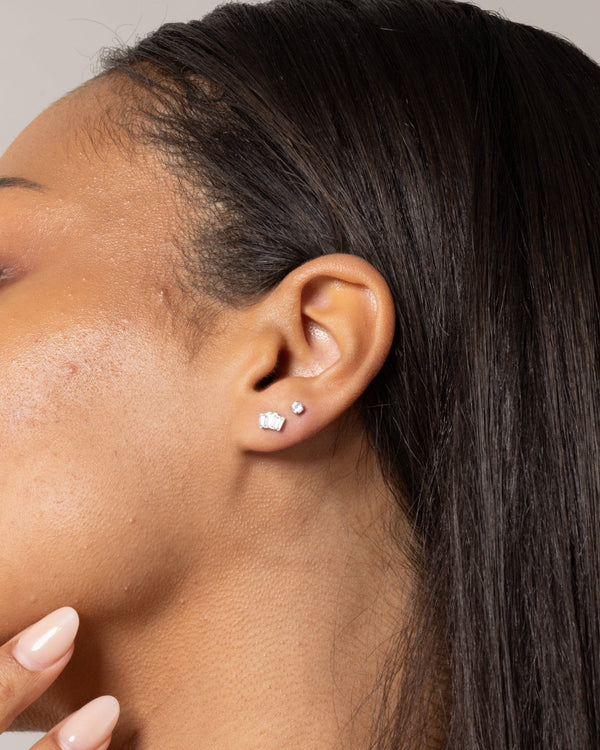
Almost any ear placement: lobes, helix, flat helix, tragus, conch and rook all take labret-style flat backs, which is why piercers favour them. The same format in longer lengths is also used for lip piercings, which is where the name labret comes from.
References
- Association of Professional Piercers. "Jewelry for Initial Piercings." APP
- Muntz HR, Cui DJ, Asher BF. "Embedded earrings: a complication of the ear-piercing gun." International Journal of Pediatric Otorhinolaryngology, 1990; 19(1):73-76. PubMed
- Kim MM, Goldman RD. "Ear-piercing complications in children and adolescents." Canadian Family Physician, 2022; 68(9):661-663. PMC
- ASTM International. "ASTM F136-13(2021)e1: Standard Specification for Wrought Titanium-6Aluminum-4Vanadium ELI Alloy for Surgical Implant Applications." ASTM
- CEN. "EN 1811: Reference test method for release of nickel from all post assemblies which are inserted into pierced parts of the human body and articles intended to come into direct and prolonged contact with the skin." CEN
- Sidambe AT. "Biocompatibility of Advanced Manufactured Titanium Implants: A Review." Materials, 2014; 7(12):8168-8188. PMC
- Thyssen JP, Menné T, Johansen JD. "Excessive nickel release from earrings purchased from independent shops and street markets: a field study from Warsaw and London." Journal of the European Academy of Dermatology and Venereology, 2011; 25(9):1021-1026. PubMed
- Schuttelaar MLA, Ofenloch RF, Bruze M, et al. "Prevalence of contact allergy to metals in the European general population with a focus on nickel and piercings: The EDEN Fragrance Study." Contact Dermatitis, 2018; 79(1):1-9. PubMed